
Zones and records
DTM answers DNS authoritatively for the zones you create on it. Everything else about traffic management, health, load balancing, and failover, is expressed as records inside those zones.
A zone is a DNS namespace DTM owns, such as example.internal.. Create a
zone before adding records to it. Each zone has:
- A name (a fully-qualified domain, with a trailing dot, e.g.
example.internal.). - A default TTL applied to records that do not set their own.
- An optional default load-balancing policy inherited at resolve time by records that do not set their own (a record’s own policy always wins).
- SOA fields (primary nameserver, admin contact, refresh, retry, expire, minimum). DTM fills sensible defaults; you only set these if you need specific values. The zone serial is managed for you.
DTM synthesizes the zone’s SOA and NS records automatically, so you never
maintain those by hand. If you do create explicit apex NS records (or
nameserver host records), yours replace the synthesized ones everywhere,
including zone transfers.
A zone is created active and reaches the rest of the cluster within
moments. pending appears only when a zone is explicitly created with
status: "pending" (replication-aware activation); it flips to active once
peers acknowledge the broadcast. See
troubleshooting if a zone stays pending.
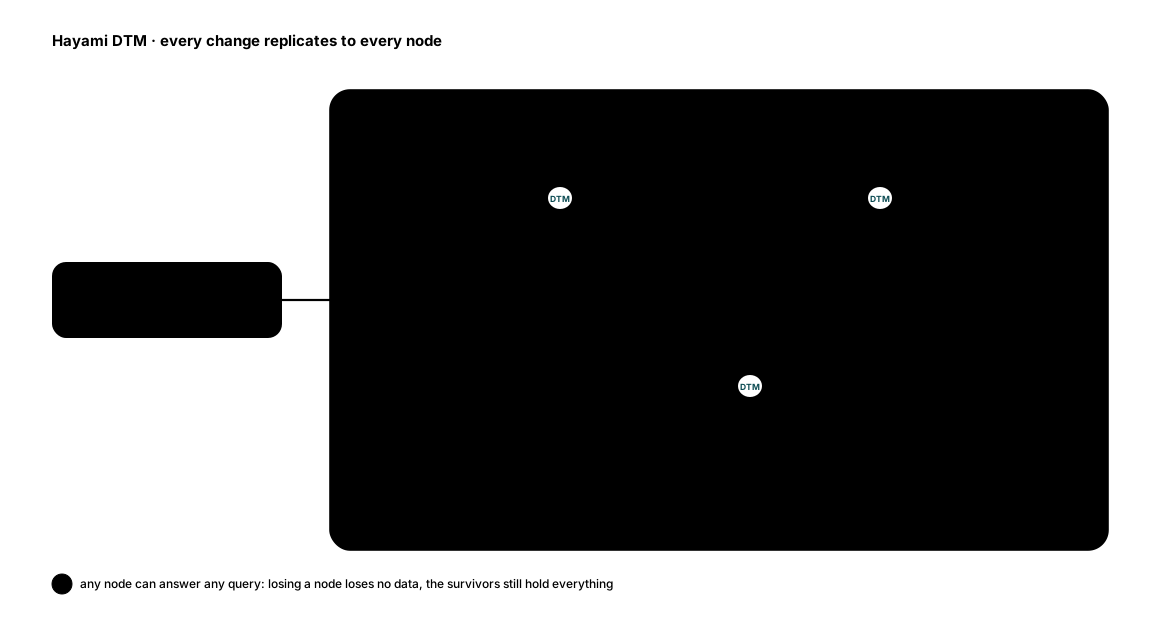
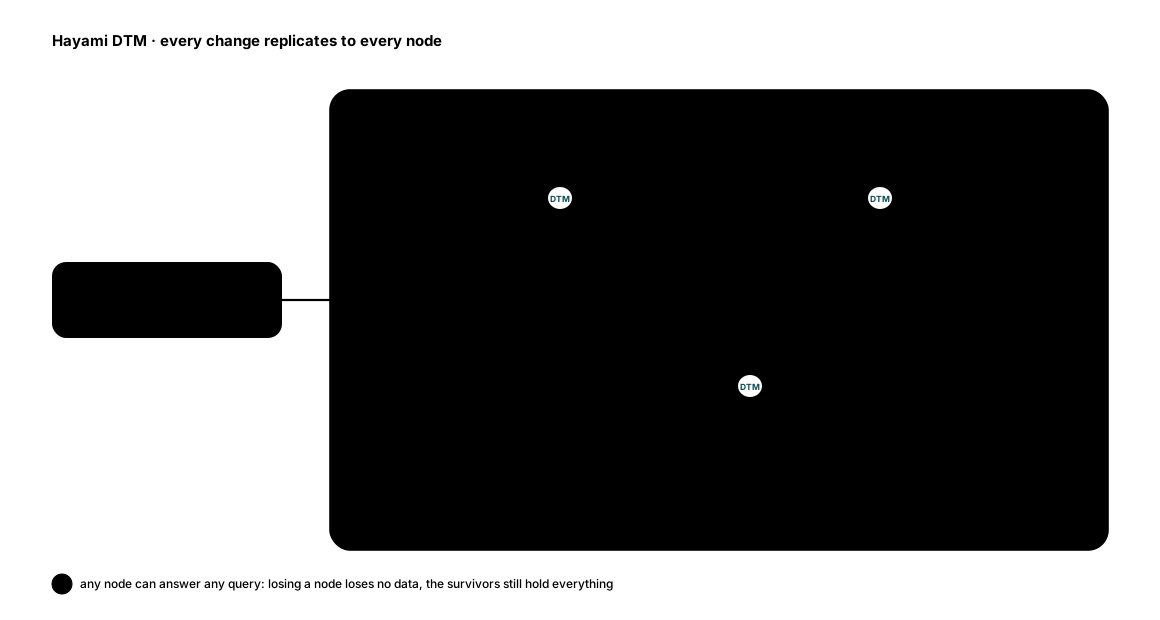
That propagation is how every change works in DTM: create or update a zone or record on any node, through any management surface, and it is stored durably and replicated to every other node, so every node serves the same answers and losing a node loses no data.
You can create zones from the web UI, the REST API, or the Terraform provider. You can also import existing zones from BIND, Windows DNS, Azure DNS, and other sources.
Deletion locks
Section titled “Deletion locks”A zone can carry a deletion lock. While it is set, deleting the zone fails
with a conflict (409) on every surface: the lock is enforced server-side, so
the API, Terraform, and the UI all honour it. Deleting a locked zone is a
deliberate two-step: clear the lock first, then delete. There is no one-shot
force override.
A cluster-wide default (default_zone_deletion_lock, set alongside the
bulk-delete cap)
makes new zones start life locked. It applies at creation only: turning it
on never retroactively locks existing zones, and an explicit
deletion_lock: false on create always wins over the default. The lock
replicates like any other zone state, so a lock set on one node is enforced
everywhere once it has converged (typically a few seconds).
Individual records have their own guardrail, the protected flag; see
delete guardrails.
Records
Section titled “Records”A record has a name (relative to the zone, or @ for the zone apex), a
type, a TTL, and one or more values. Supported types:
| Type | Holds | Notes |
|---|---|---|
A |
IPv4 address | Load-balanceable, health-checkable |
AAAA |
IPv6 address | Load-balanceable, health-checkable |
CNAME |
Canonical hostname | Exclusive at a name; cannot sit at the apex |
MX |
Mail exchanger | Uses priority |
NS |
Delegation nameserver | |
PTR |
Reverse pointer | |
SRV |
Service location | Uses priority, weight, port |
TXT |
Text | |
CAA |
Issuance authorization (RFC 8659) | tag is issue, issuewild, or iodef; the CAA flag (0 to 255) rides the priority field. |
ALIAS |
Downstream hostname(s) | Apex-safe; DTM keeps the targets resolved and health-checked for you. See ALIAS records |
Automatic reverse (PTR) records
Section titled “Automatic reverse (PTR) records”Set Maintain reverse (PTR) records on a forward zone (the
maintain_reverse flag, available in the web UI, the API, and the
dtm_zone Terraform resource) and DTM maintains the matching PTR record
whenever an A or AAAA record in that zone is created, updated, or deleted
through the record API. The target reverse zone
(in-addr.arpa / ip6.arpa) must already exist on DTM and be active; DTM
never creates it for you. Auto-generated PTRs are owner-tagged: DTM only ever
updates or removes the ones it created, never a PTR you wrote yourself, and a
failure to maintain a PTR never fails the forward write.
Values
Section titled “Values”A record can carry several values. For A/AAAA records, each value is a
backend address that DTM can health-check and load-balance. A value may also
carry:
- a region tag, used by region-aware load balancing (DTM can also infer it from the address using your subnet mappings);
- priority, weight, and port for record types that use them
(
MX,SRV).
Wildcard records
Section titled “Wildcard records”DTM serves standard single-label wildcard records: a record named * (or
with * as the left-most label, such as *.apps) answers queries for names
one label below it that do not otherwise exist.
- One label per wildcard.
*.example.internal.answersweb.example.internalbut notweb.eu.example.internal; create*.euif you need the deeper level. Wildcards can be nested (*.appsand*.svc.appscoexist, each covering its own level). - An exact record always wins over the wildcard for its name.
- Standard DNS wildcard rules apply (RFC 1034): a name that exists with
any record type is never answered by the wildcard (a name holding only a
TXTrecord returns an empty answer for anAquery rather than the wildcard’s address), and the zone apex is never covered by*. - A wildcard
CNAMEanswers queries of any type for matching names. - At resolution time a wildcard record behaves like any other record: its values pass through the same health-filtering and load-balancing pipeline.
Create a wildcard like any other record: use * (or *.sub) as the record
name in the UI, API, or Terraform, or import it in a BIND
zone file. The * must be the whole leftmost label; partial names such as
web-* are rejected.
The TTL controls how long resolvers cache the answer. Because DTM serves private
zones where you control the resolvers, low TTLs (for example 30 or 60
seconds) are practical and give fast failover. A record with no TTL (or an
explicit 0) inherits the zone’s default; the ceiling is the DNS wire maximum
of 2147483647 seconds (RFC 2181), and the API rejects anything larger.
Load balancing and health
Section titled “Load balancing and health”Two optional pieces turn a plain record into a traffic-managed one:
- A load-balancing policy decides which of the healthy values to return to a given client. See load-balancing methods.
- A health-check template tells DTM how to probe each value so it can return only the healthy ones. See health checks.
A record with neither, in a zone with no default policy, simply returns all of its values in declaration order.
Beyond plain records
Section titled “Beyond plain records”- ALIAS records (GSLB) point a name at downstream hostnames (even at the zone apex) and resolve, health-check, and region-balance them for you.
- Override records make a single name in an otherwise forwarded zone health-aware, without recreating the zone.
- Forwarders and stub zones hand queries for other namespaces off to upstream resolvers.