
Override records
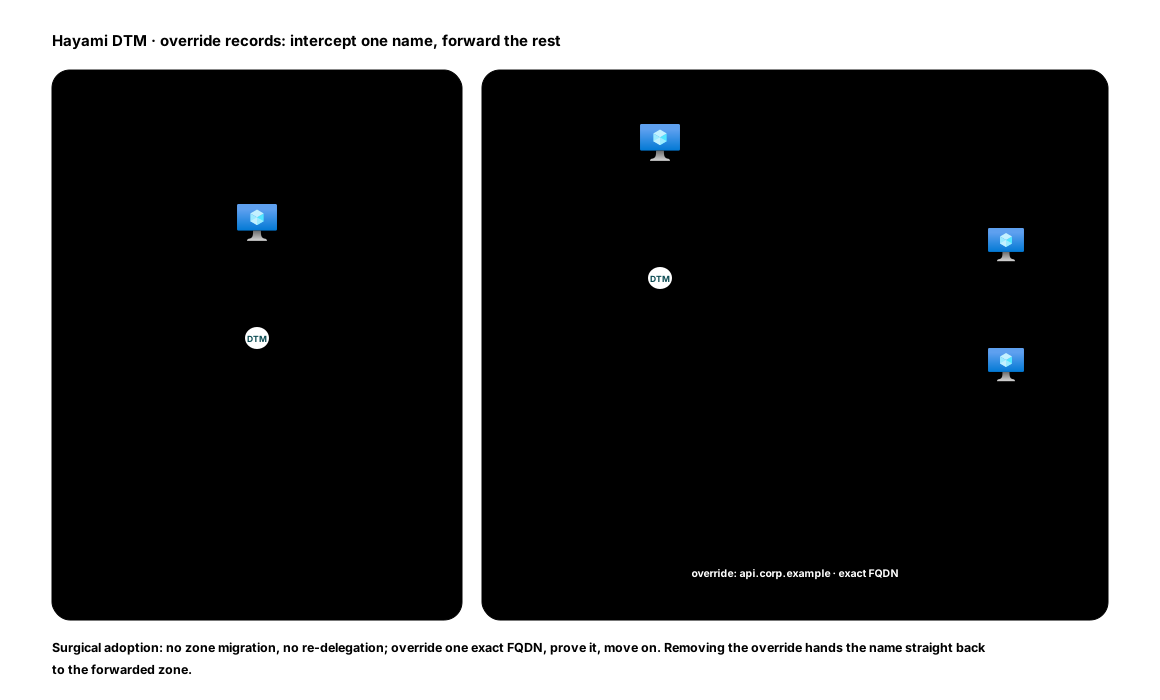
An override record lets you put Hayami DTM in front of one name in a zone that DTM otherwise forwards. Every other name in the zone keeps resolving exactly as it does today; only the name you override is answered by DTM, with the same health-checking, load-balancing, and failover it applies to an ALIAS record.
It is the same engine, aimed at a different problem: surgical adoption. You don’t recreate the zone, re-delegate it, or migrate every record. You override a single name, prove it, and move on.
Why it matters
Section titled “Why it matters”Most zones already exist and already resolve, whether through Azure-provided DNS, an on-prem resolver, or another authoritative server that DTM forwards to. You rarely want to take ownership of the whole zone just to make one name health-aware and region-balanced.
An override record does exactly that: DTM answers that one name with health, load balancing, and cross-region failover, and forwards everything else untouched. No big-bang cutover, no zone to rebuild: adopt DTM one name at a time.
Set one up
Section titled “Set one up”Override records are managed from all three surfaces: the REST API, the
Terraform provider (dtm_override_record), and the web UI (write
actions need the admin role). Because an override changes how an existing name
resolves for every client, the UI write flow is deliberately guardrailed: the
form previews where the name resolves right now, the confirmation restates the
concrete effect before you commit, “create disabled” is offered as a
reversible first step, and deleting an override means typing its FQDN. It also
warns when the FQDN sits inside a DTM-authoritative zone, where an override
would never be consulted. Terraform remains the recommended steady-state
owner; see the ownership rule.
An override is keyed by an exact FQDN and a target mode:
linkedtargets are hostnames that DTM keeps resolved and health-checked for you, just like an ALIAS record.statictargets are fixedA/AAAAaddresses you control directly.
Example: override one name in a forwarded zone
Section titled “Example: override one name in a forwarded zone”This overrides api.corp.example (leaving the rest of corp.example forwarded)
and points it at two regional endpoints with health-aware failover:
curl -X POST https://<dtm>/api/v1/overrides \ -H "Authorization: Bearer <token>" \ -H "X-DTM-CSRF: 1" \ -H "Content-Type: application/json" \ -d '{ "fqdn": "api.corp.example.", "type": "A", "target_mode": "linked", "ttl": 30, "values": [ { "value": "api-ne.contoso.com", "region": "northeurope" }, { "value": "api-we.contoso.com", "region": "westeurope" } ], "lb_policy": { "method": "region" }, "health_check_template": { "protocol": "https", "port": 443, "path": "/healthz", "interval_seconds": 5 } }'For the Terraform equivalent, see ALIAS, GSLB and overrides.
- A linked target (hostnames, as above) is resolved, health-checked, and region-balanced just like an ALIAS, so DTM follows the backends and fails over automatically.
- A static target pins fixed
A/AAAAaddresses instead; use it when the override should answer with addresses you control directly. health_check_templateis optional and accepts the full set of probe types, including authenticated probes, so you can override a name that points at auth-gated backends.
How it behaves
Section titled “How it behaves”- Only the overridden name changes. Every other name in the zone keeps resolving exactly as before; DTM forwards it untouched.
- TTL is whatever you set on the override, independent of the forwarded zone’s TTLs, so clients fail over quickly.
- When targets degrade, unhealthy ones are dropped from the answer and traffic shifts to the remaining healthy targets, including across regions.
- Removing the override hands the name straight back to the forwarded zone, so adoption is reversible.
Good to know
Section titled “Good to know”- An override applies to a single name, not a whole zone, and that’s the point.
- It uses the same health-checking, load-balancing, and failover engine as ALIAS records; the difference is scope, not capability.
Need a hand? Email [email protected].